




Lithium Batteries: The Hazmat Challenge Redefining Automotive Logistics
Your Executive Summary (TL;DR):
The Shift: Nearshoring has transformed Mexico into an electric vehicle (EV) export powerhouse, boosting production at a 10-to-1 ratio compared to domestic consumption.
The Risk: Moving lithium cells isn't traditional logistics; it's managing a material classified as Class 9 Dangerous Goods prone to thermal runaway. A single error in paperwork or stowage and your container will be confiscated.
The Solution: Immediately adapt your supply chain to the new and stringent NOM-043-SCT-SEMAR-ARTF-2023 and adopt advanced IoT telemetry under a 4PL logistics model.
The Benefit: Mastering the Hazmat ecosystem provides complete protection against foreign trade penalties, ensuring your just-in-time production lines never stop.
The Myth of Easy Relocation: Produce More, Risk More
The boom of Nearshoring in Mexico isn't just about moving steel parts or common components. The true strategic core of electromobility in North America pumps through lithium-ion batteries.
Here's the financial reality you need to face: the local market for pure electric vehicles contracted by $13.9\%$ due to a lack of infrastructure. However, national production of these vehicles surged by $20.5\%$, exceeding $204,000$ units annually.
Your operation is purely export-oriented. This means that cross-border transport of unstable chemical components is a daily game of Russian roulette if your forwarder doesn't master the high technical specialization required.
The New Regulatory Ecosystem: If You Don't Comply, You Don't Cross
Forget old practices. The landscape of foreign trade in Mexico has been modernized with the entry into force of NOM-043-SCT-SEMAR-ARTF-2023, which definitively superseded the 2003 version.
The Transport Document Trap
Unlike in the past, the new regulation no longer only obligates the shipper and carrier; it now legally and co-responsibly binds the consignee. If the document does not include the correct UN number with pinpoint accuracy (UN3480 for loose batteries or UN3481 if integrated), your sea or air shipment will be completely rejected.
Does your team understand the difference in regulatory impact?NOM-043-SCT/2003: Only regulated the shipper and ground carrier.NOM-043-SCT-SEMAR-ARTF-2023: Obligates the entire multimodal chain (including you).
The UN 38.3 Protocol: The International Litmus Test
For your components to even be considered suitable for mass transport, they must mandatorily pass 8 severe laboratory tests simulating altitude, vibration, and extreme short circuits. Furthermore, airlines under IATA regulations and maritime carriers strictly require a State of Charge (SOC) of $\le30\%$. If you ship a battery with a charge level higher than allowed, you are violating international safety laws..
Multimodal Operational Strategy: From Ports to the Production Floor
The efficiency of your logistics supply chain depends on differentiating packaging according to the type of stowage, while managing costs and ensuring safety.
RoRo (Roll-on/Roll-off) Vessels
When exporting the finished vehicle with the battery installed, the key is constant temperature and ventilation control in enclosed decks. Even a minor oversight can trigger a chain reaction that is impossible to extinguish.
LoLo (Lift-on/Lift-off) Vessels
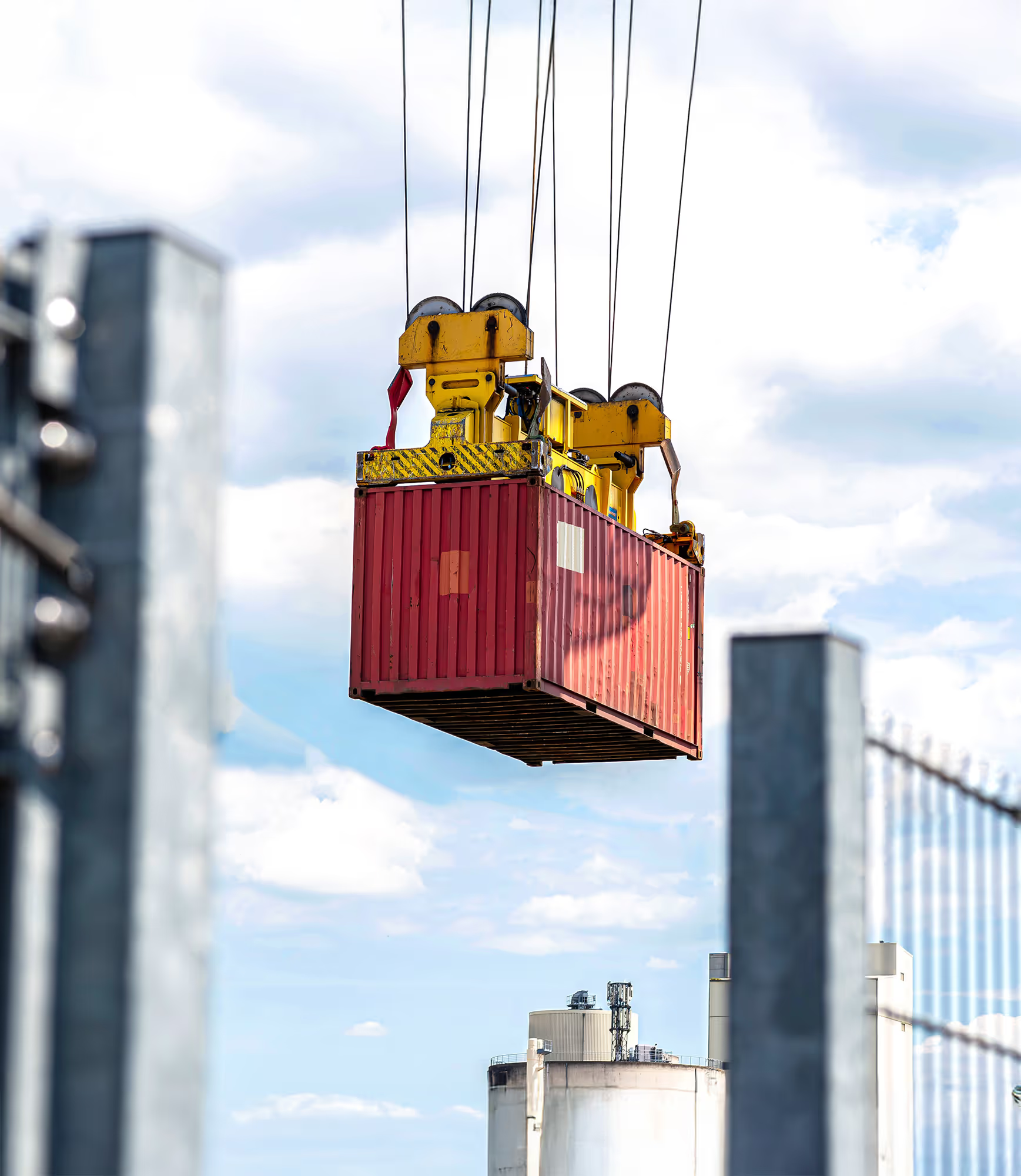
For importing loose cells or modular packs from Asia, the approach completely shifts to using container cranes. Cells must be transported under strict Packaging Group II certifications. If you transport damaged or defective batteries, it is mandatory to apply SCT instruction P908. Otherwise, you risk the container being impounded due to a latent fire risk.
For oversized components or complete substations in industrial plants, the operation must be managed as project cargo, requiring prior intermodal route studies and special risk permits.
Storage Yards: The 4PL Logistics Revolution
Transfer yards are the most vulnerable areas in your business. An invisible impact during loading operations can cause an imperceptible internal short circuit that leads to a catastrophic fire days later.
To neutralize this economic and operational threat, your company must transition to a model of 4PL logistics driven by cutting-edge technology:
- 🤖 IoT and AI Monitoring: Deploy sensors on pallets to measure temperature and vibration every ten seconds. Anticipating ignition is the only way to save your inventory.
- 🌡️ Temperature-Controlled Infrastructure: Negligent storage accelerates the chemical degradation of cells. Consequently, this market is growing at an annual rate of $4.94\%$; climate control is no longer a luxury, it's an operational necessity.
- 🚒 Strict NFPA Compliance: Design your distribution centers in alignment with NFPA 13 and NFPA 30 guidelines. If your active safety systems fail, insurers won't pay a single dollar.
Conclusion: Compliance isn't an expense, it's your greatest business advantage.
In the competitive Nearshoring environment in North America, the success of your automotive plant isn't measured by how many units you can manufacture, but by the legal resilience of your supply chain.
Omitting UN 38.3 standards or failing to complete Hazmat documentation under NOM-043 will freeze your just-in-time operations and destroy your profit margins due to severe foreign trade penalties. Investing in robust technical governance is the only way to safeguard your business and transform it into a market leader..
Would your current supply chain withstand a federal Hazmat audit under the new NOM-043?
{{asesoria-light}}






Everything your logistics needs

.png)
%20(2).png)